
Quick Specs
- Type: Stick incense holder
- Size: 5 inches
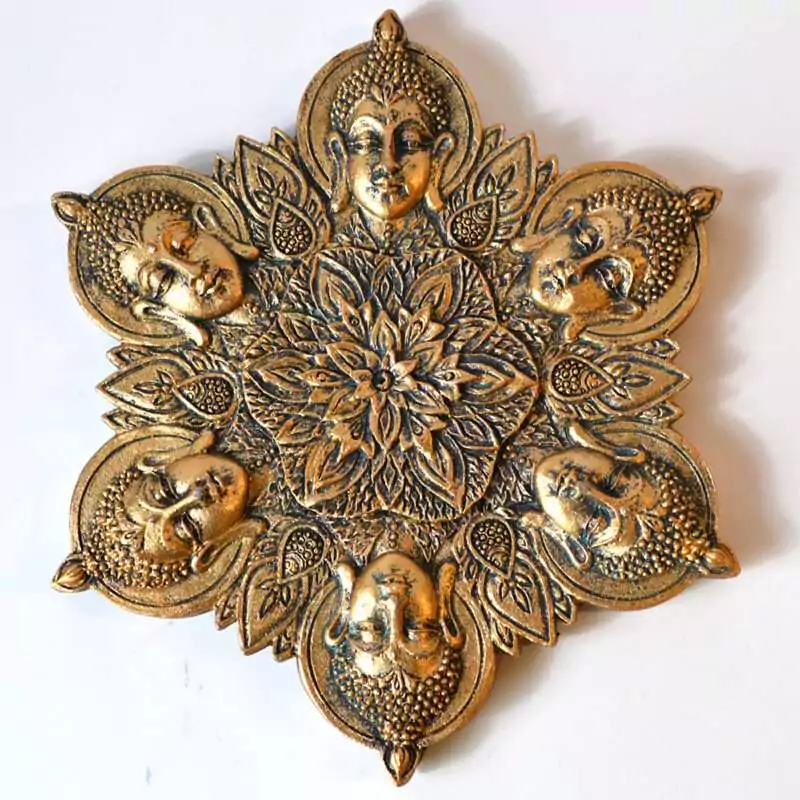
- Design: Six Buddha heads in halo medallions around a lotus mandala
- Outline: Six-pointed star with lotus-bud tips
- Finish: Antiqued gold with blue-green patina in the recesses
- Center: Small hole in the middle of the mandala
Six Buddha Heads Around a Lotus Mandala
The holder is shaped like a six-pointed star, and each point is a medallion framed by a halo and tipped with a lotus-bud finial. A Buddha head fills each medallion: a calm face with lowered eyes and fine lines marking the brows and lips, long earlobes, and a domed topknot covered in rows of small curls. The heads are arranged around the center like petals, each one with its crown pointing outward, so the top head faces upright, the bottom head faces down, and the four in between sit at angles. Between the medallions, pointed petals and teardrop shapes patterned with dots and fine lines fill the spaces. At the center, a lotus mandala of layered petals spreads out from a small round hole. The finish is an antiqued gold, bright on the raised faces and edges, with blue-green patina darkening the recesses so the curls, petals, and halos stand out. The holder measures 5 inches.
Buddhism is a living religion, and images of the Buddha belong to its practice. Early Buddhist art was largely aniconic, showing the Buddha only through symbols and relics, and images of the Buddha as a person began to emerge from the first century CE in northern India, in Gandhara and Mathura. Buddhist teaching reads the lotus as a symbol of the Buddha and his awakening, and the flower appears in early Buddhist art at sites such as Sanchi and Bharhut. The lotus at the center joins the pattern to another old symbol of the tradition, since the lotus rises from muddy water unstained, and a circle holding a flower is among the common mandala arrangements. Buddhist mandalas can show many subjects, from a Buddha at the center to the universe, and they are commonly used by tantric Buddhists as an aid to meditation. This holder borrows the Buddha head and the lotus mandala as decorative forms for stick incense.
Placing the Holder in Your Home
Set the holder on a clean, raised surface, such as a shelf, a high table, or the top of a bookcase, and keep it off the floor and away from places where people stretch out their feet. Stand a stick of incense in the hole at the center of the lotus, and place a tile under the holder if the surface is wood. A quiet corner for reading, meditation, or tea suits the six calm faces, and a plain wall behind it lets the gold read clearly. Between sticks, the star shape works as a small piece of relief decor, with the gold picking up warm lamplight in the evening. My Buddhist figurines and decor collection has other pieces to set nearby, each deserving the same care.
How to Burn Incense in the Buddha Mandala Holder
Choose a clean raised spot, light the stick in the center, and let everything cool before you move it.
- Choose a Clean, Raised, Fire-Safe Spot
Pick a clean, raised surface and set the holder on a flat, heat-resistant base such as a ceramic tile or a metal plate. Keep curtains, clothing, and paper well away from it, and keep it out of reach of children and pets.
- Seat the Stick in the Center and Light It
Push the thin end of a stick into the small hole at the center of the mandala and light the tip until it glows, then shake out the flame. Stay in the room while it burns, since fire services advise never leaving burning incense unattended. Keep the stick upright and clear of the medallion rims so the ash falls onto the holder.
- Let It Burn Out and Cool Down
Make sure the stick is completely out before you leave the room or go to bed. Incense ash and holders may stay hot after use, so wait until the holder is cool to the touch before you move it, and clear the ash only when it is cold.
The Tarot Fellow Standard
I stock this holder as a decorative reference piece: a 5 inch stick incense holder that borrows the Buddha head and the lotus mandala from Buddhist art. A Buddha image is an object of respect for Buddhists, so I’d ask you to keep this holder in a clean, raised place and to see it as a way into learning about Buddhism. Temples, meditation centers, and teachers are where the practice lives. Browse my stick incense collection for sticks to burn in it.
Frequently Asked Questions
Buddhist custom treats Buddha images with care. A common practice puts the image on the highest spot in the room, and devotees avoid raising their heads above it or pointing their feet at it. In most Buddhist traditions, images are regarded as more than representations. Keeping this holder clean, raised, and out of casual use fits that custom, and a local temple or Buddhist teacher can say more about how images are honored.
Offerings are given out of respect and humility to a Buddha image or other object of devotion. Buddhists may offer flowers as a symbol of growth, or incense to remind themselves of the odor of sanctity of the Buddha, and candles and lights can be offered to symbolize dispelling the darkness of ignorance. Such offerings are signs of respect and are also meant to change the environment of the devotee.
The bump at the top of the head is the ushnisha, and it represents spirituality, wisdom, and awakening. It is one of the features shared by Buddha images, along with elongated earlobes, which are described as vestiges of his life as a prince, when he wore extravagant jewelry.

Reviews
There are no reviews yet