
Quick Specs
- Type: Goddess statue
- Height: 9 1/2 inches
- Material: Resin
- Finish: Bronze-toned
A Hooded Goddess With a Spiral Dish
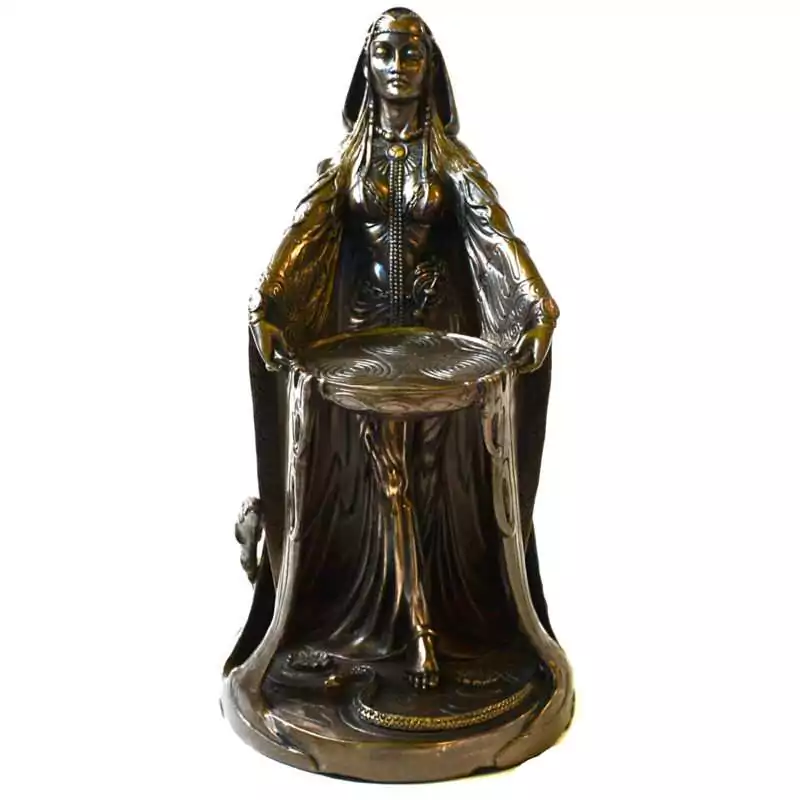
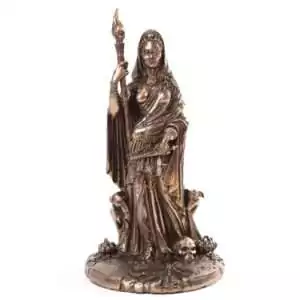
Danu stands upright and barefoot, wrapped in a hooded cloak that falls from her shoulders to the base in long folds. Long hair hangs past her shoulders beneath the hood, and a circlet crosses her forehead. A necklace with a round pendant rests on her chest, and a line of studs runs down the front of her gown to a small ornament at the waist. Spirals are carved along the edges of her sleeves. Her hands hold a shallow round dish at waist height, and its face is carved with triple spirals. At her feet, a snake with gold-highlighted scales coils through ripples of water between two flowers, all on a round base. The bronze finish is bright on the raised folds and darker in the recesses, which gives the cloak depth and makes her face and hands stand out. Her eyes are lowered, her expression is composed, and her outline is slim, so she holds a shelf with a quiet, upright line. The dish at her waist is the focal point, the place where the spirals gather and the eye settles.
Danu’s record is thin. The name of the Tuatha Dé Danann, the divine people of Irish mythology, is the only place the medieval Irish texts attest her. The form Danu itself is a scholars’ reconstruction from the genitive Danann, which appears in the name of the Tuatha Dé Danann. Victorian folklorists later gave her motherhood and agricultural prosperity, and many modern Pagans honor her as a mother goddess of the Irish gods. The dish, the snake, and the water flowers on this statue come from the sculptor’s design: the dish rests in her hands, and the snake and the flowers sit at her feet. The spirals themselves are at home in Celtic art, where spirals, step patterns, and key patterns dominate the styles that predate Christian influence. That leaves you free to read the dish, the snake, and the water in your own way. She is a figure of Irish mythology, shown here in Celtic-style ornament, and modern Pagan paths honor her in their own ways. Each is a fair way to know her.
Display and Devotional Uses
On an altar, Danu can anchor a space for the Tuatha Dé Danann, for Irish mythology, or for a mother aspect of the Goddess. The shallow dish at her waist can hold one small item, such as a flower or a polished stone, if your practice includes offerings. Since water and a snake sit at her feet, a river stone or a small bowl of water nearby echoes the design. She also suits a shelf of Irish folklore and myth. Set her beside altar tools from my ritual offering bowls and plates collection, or give her a corner of her own with room around the dish so the spirals stay visible. A plain-colored altar cloth under her lets the bronze finish stand out.
How to Set Up and Care for the Danu Statue
Three steps for placing her, filling the dish, and keeping the bronze finish clean.
- Find a Steady Place
Set her on a flat, stable surface where the dish sits near eye or chest level, so the spirals can be seen. Keep her back from the edge, since a fall onto a hard floor can chip or crack a resin figure. Leave a little space on each side so her cloak and sleeves read as a clean outline.
- Decide What the Dish Holds
Choose one small item for the dish, such as a fresh flower, a stone, or a feather. Skip food that spoils or draws insects, and keep candle wax, incense ash, and oils away from the dish, which can stain the finish. If you add anything damp, wipe the dish dry afterward so no moisture sits in the carved spirals.
- Keep the Bronze Finish Clean
Run a soft, dry brush through the folds of the cloak and the recesses around the snake, since dust settles in the dark hollows first. Metal polish and cleaning sprays can dull a bronze-toned finish, so a dry cloth is enough for fingerprints. Lift her by the base with both hands, which supports her whole weight.
The Tarot Fellow Standard
I stock this Danu statue because it gives a hard-to-picture goddess a clear, dignified form: a robed figure who holds out a dish. Her record in the old texts is slim, so the statue suits a practice that is comfortable building devotion from a few sources and your own experience. Celtic Pagan and Celtic reconstructionist paths are living religions with their own communities, and a figure on a shelf supports your own practice alongside them. Browse my gods and goddesses collection for more figures.
Frequently Asked Questions
Danu is usually said DAH-noo, with the stress on the first syllable and a final sound like the oo in moon, which is close to the Irish pronunciation. English dictionaries give Tuatha Dé Danann as TOO-uh-huh day DAH-nun. Irish speakers shape some of the sounds differently, so you'll hear several versions of both names.
Medieval texts say the Tuatha Dé Danann, usually translated as the folk of the goddess Danu, came to Ireland and defeated the Fomorians. The Milesians then landed and beat them at Tailtiu. The poet Amergin, asked to divide the land, gave the part above ground to his own people and the part underground to the Tuath Dé, who withdrew into the sídhe mounds. Later folklore remembered them as the fairy folk, the aos sí.
Possibly. Cormac's Glossary, an early Irish text, names Anu as the mother of the gods, and some scholars think Anu and Danu are one goddess, with Danu perhaps a contraction of goddess Anu. Others treat Anu as a separate figure. In the Book of the Taking of Ireland, the closest match to Danu is Danand, a daughter of Delbáeth whose three sons are called the gods of Dannan.
The meaning is still debated, and the debate dates to the nineteenth century. One theory ties the name to an Indo-European root meaning to flow, which may also lie behind the river name Danube and the Vedic water goddess Danu. Another links it to the Old Irish dán, meaning skill, as in the aes dána, the people of skill. The linguist Eric Hamp proposed instead a root meaning good.
The medieval texts barely mention her. Modern Pagan traditions often honor Danu as a mother goddess, and some revere her as a triple goddess, either on her own or alongside the Morrígan. Sources describe little agreement about what she represents, and many practitioners treat her as a blank slate for their own devotion. Reading the Irish texts that mention the Tuatha Dé Danann makes a sound place to start.
Reviews
There are no reviews yet