
Quick Specs
- Type: Evil eye wall hanging
- Length: 9 inches
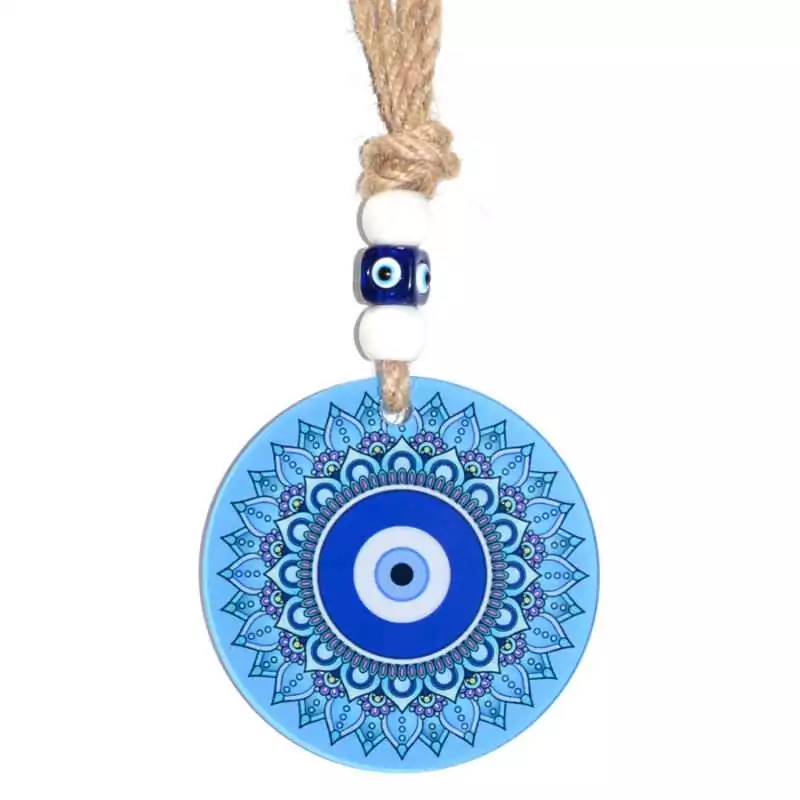
- Disc: Round printed glass, 3 1/4 inches
- Design: Blue eye ringed by petals in light blue, teal, violet and green
- Cord and beads: Natural-colored twine, two white round beads and a blue cube bead with eyes
A Printed Eye Inside Rings of Petals
The disc is a flat circle in a clear light blue, and the printed design fills most of it. At the center, a dark blue circle holds a white ring, a pale blue iris and a black pupil. Around the eye the pattern opens like a flower seen from above: a ring of tiny oval petals in violet and green, then pointed petals in teal and pale blue, then a wide outer ring of longer petals dotted with small circles, with violet flowers and yellow-green centers tucked between them. The twine knots at the top and runs down through a white round bead, a small blue cube bead with an eye on its faces, and a second white bead before it reaches the hole at the top of the disc. Each petal is outlined in a darker blue, so every ring has a crisp edge against the lighter fill. The pale background makes the dark center the first thing you see, and the petals reward a closer look. The whole hanging is 9 inches long, and the disc is its widest part.
Glass and the eye have a long history together. A museum catalogue lists glass eye beads among the commonest amulets against the evil eye, worn or carried, and says such amulets usually take an eye-shaped design, realistic or highly stylised. The eye on this disc is a stylised one, drawn as rings around a dark center. The evil eye itself is the belief that a malevolent glare, usually inspired by envy, can bring harm, and reference works find it across the Mediterranean, West and South Asia, Africa and Latin America. In Turkey the amulet is called nazar boncuğu, and in Greece it’s called mati. Accounts of the custom describe such amulets hung in houses, shops and cars, which makes a wall-sized eye a natural fit for a doorway or an entry hall. The small cube bead above the disc carries more eyes on its faces, so the hanging holds one large printed eye and several small ones. The twine and white beads frame the disc in a soft, neutral color.
Practical Ways to Display It
Hang it where the pale blue stands out: against a dark door, a deep-colored wall or a wooden frame. Good spots include the side of a front door, a hallway, a bedroom wall or a desk corner. Hang it at eye level so the fine printed petals are easy to see. The twine hangs from a single hook, so any small nail will do. A window frame, a closet door or the end of a bookshelf also works, and the hanging can move from room to room whenever you like. It also works as a gift for a new home, a new office or a first apartment. Keep the small beads out of reach of young children. For more pieces made to hang, see my wall hangings collection.
How to Hang and Care for the Printed Glass Eye Hanging
Three steps cover the first check, the hanging and gentle cleaning.
- Check the Twine and Beads
Hold the twine above the knot and let the disc hang free. Look at the knot, the two white beads and the blue cube bead, and give each a light tug to check that it sits firmly. Run a finger around the edge of the disc to feel for chips or rough spots before it goes on the wall, and look at the hole where the twine passes through for any wear.
- Hang the Disc
Set a small nail or hook into the wall at the height you want, then hang the twine from it and let the disc settle. Stand back and check that it hangs straight and that nothing within a few inches of the disc can knock it. A glass disc can chip or crack against a hard edge, so choose a spot away from door swings, shelves and busy walkways.
- Wipe Gently
Wipe the disc with a soft dry cloth every few weeks to lift dust and fingerprints, and handle it by the edges. Dust the twine and the beads with a soft brush. Take the hanging down before any painting or wall cleaning, and store it in a drawer or box with soft paper around the disc so it stays clear of hard objects.
The Tarot Fellow Standard
I stock this hanging because it offers a large, easy-to-read eye on a disc at a size that suits a door or a small wall. The evil eye is a living folk belief in Turkey, Greece and many other places, and this piece is a decorative charm that refers to it, a reference and never a stand-in for the customs of the people who keep them. If the nazar belongs to your family’s tradition, you already know how it’s gifted, hung and replaced. If it’s new to you, learn those customs before you decide what the eye means in your home. See my evil eye collection for more pieces that carry the eye.
Frequently Asked Questions
Two explanations circulate. In Turkish belief, blue acts as a shield against evil and absorbs negativity. A second points to places such as the Aegean, where light eyes are rare, so people with blue or green eyes were thought able to cast the curse, and a blue eye answers them. Reference works note a strong cultural link between the evil eye and the color blue.
Traditional nazars are handmade glass with concentric circles or teardrop shapes in dark blue, white, light blue and black, sometimes with a yellow or gold edge. One account lists the glass mixture as molten glass with iron, copper, water and salt, ingredients said to shield against evil. A museum catalogue lists glass eye beads among the commonest evil eye amulets.
Accounts from several cultures describe children as especially vulnerable to the evil eye. Turkish accounts describe pinning a nazar to a newborn's clothing, and in Mexico and Central America infants often wear an amulet bracelet with an eye-like spot. Customs differ by family and region, so follow the practice you were taught if you have one.




Reviews
There are no reviews yet