

Quick Specs
- Type: Pendulum with beaded chain
- Weight: Lepidolite, six-sided point
- Chain: Silver-toned, with seven small round beads
- Accent: Cluster of colored chips at the far end of the chain
- Theme: Seven chakra colors
A Lepidolite Point on a Seven-Color Chain
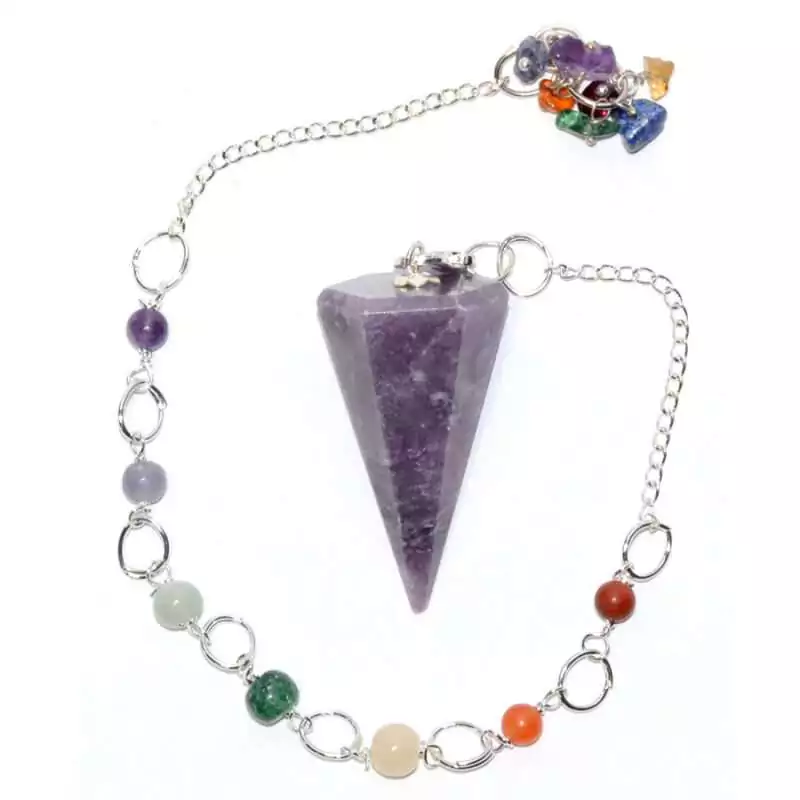
The weight is a six-sided point of lepidolite, a mica that ranges from pink through lilac to purple. This one is a mid purple mottled with paler flecks, and its six flat faces taper to the tip, with a small silver-toned cap at the top where the chain attaches. Lepidolite carries lithium in its structure: it is the most abundant lithium-bearing mineral and a minor ore of the metal. Manganese gives lepidolite its pink and purple shades. It is a soft stone, and like other micas it splits into thin flakes in one direction. It forms in granite pegmatites, the coarse rock left from the last stage of a magma’s crystallization, and Brazil, Madagascar, and the United States are among its sources. The chain holds seven small round beads, running from violet through green and cream to orange and red, and at the far end a small cluster of colored chips hangs from the last ring. Those seven colors refer to the chakras of modern chakra practice, so the beads read as a color key beside the stone.
A pendulum is a weight hung from a cord or chain, held in one hand and watched as it swings. People use weights of stone, crystal, and metal, and many choose by how a piece looks and feels in the hand. Dowsing with forked twigs is documented in Europe from the sixteenth century, and some modern dowsers hold a pendulum weight on a short cord, a practice that carried over into modern witchcraft and New Age work as a tool for yes-or-no questions. Guides for people who use one suggest short, clear questions, a calm frame of mind, and treating the answer as one input among several. In crystal practice, lepidolite is associated with the crown chakra and with the zodiac sign Libra, which gives the stone a natural place at the top of a seven-color chain. The six flat faces give the point crisp edges that catch the light as it turns. You can hold it over a printed chart, over a bare table, or simply keep it on your altar as a focus for a quiet minute of attention before you begin a reading or a ritual.
Practical Ritual Applications
Hold it over a printed mat when you want the swing to have a layout to point toward; my pendulum mats and tables are made for that. Over a plain table it suits short yes-or-no questions. The seven-bead chain also serves a chakra-themed altar: lay it in a gentle curve on a cloth so the colors read in a row, with the lepidolite point resting at the end. Some people keep it beside a notebook and record the date, the question, and the swing, which turns a quiet habit into a record you can revisit later. When you are not using it, coil the chain loosely in a small dish or pouch so the beads and chips don’t tangle.
How to Use Your Lepidolite Pendulum
Three steps take you from the first grip to a recorded answer.
- Rest Your Arm and Grip the Chain
Sit upright with your elbow supported on a table. Pinch the chain between your thumb and index finger, loose enough that the point can swing but firm enough that it won't slip. Let the lepidolite hang still, take a few slow breaths, and wait until all motion has stopped before you ask anything. A steady start makes later movement easier to notice.
- Set Your Yes and No
Hold the pendulum still and ask it to show you a yes. Note which way it begins to swing, then stop it with your free hand and ask for a no. Many people set a maybe the same way. The directions belong to you, and they can change from one session to the next, so repeat this check each time you sit down. A question whose answer you already know makes a good test.
- Ask Clear Questions and Keep a Record
Ask one short question at a time, one with a definite answer, and write down the question, the swing, and the date. Put the pendulum away when you feel stressed, angry, or tired. Store the lepidolite point apart from harder stones so it keeps its edges.
The Tarot Fellow Standard
I stock this pendulum because it pairs a soft purple mica point with a chain built around seven colors, which gives you one piece for dowsing practice and for a chakra-themed altar. The beads and chips work as color cues beside the lepidolite point. A pendulum is a focus for your own attention, and the way you use it is yours to shape. It does not replace professional advice of any kind. Browse my pendulum collection to compare other weights, shapes, and chains.
Frequently Asked Questions
Early evidence for dowsing dates to the sixteenth century. A 1550 woodcut in Sebastian Münster's Cosmographia shows a dowser with a forked rod, and Georgius Agricola's De Re Metallica of 1556 includes a detailed description of dowsing for metal ore. Some modern dowsers use a pendulum weight on a short cord or thread and read the direction of its swing, and a pendulum like this one is used in that way.
Cleansing is a custom of crystal practice, and the methods people name vary: moonlight, sound from a singing bowl, smoke from a smudge stick, a rinse in water, or a day buried in soil. For lepidolite, moonlight and sound keep the surface untouched, and a crystal encyclopedia lists those two for this stone. Lepidolite is a soft, flaky mica that scratches easily, so wipe it only with a dry, soft cloth.
Chakras come from Indian traditions, where different texts count anywhere from three to eight centers. The seven-color rainbow is a modern Western arrangement. The Theosophical Society's history notes that the Indian scriptures give chakras colors but no rainbow sequence. Colors were attached gradually across the twentieth century by writers and color healers, and in 1977 the rainbow colors were first combined with a list of qualities for each chakra. A seven-bead chain draws on that modern system.



Reviews
There are no reviews yet