
Quick Specs
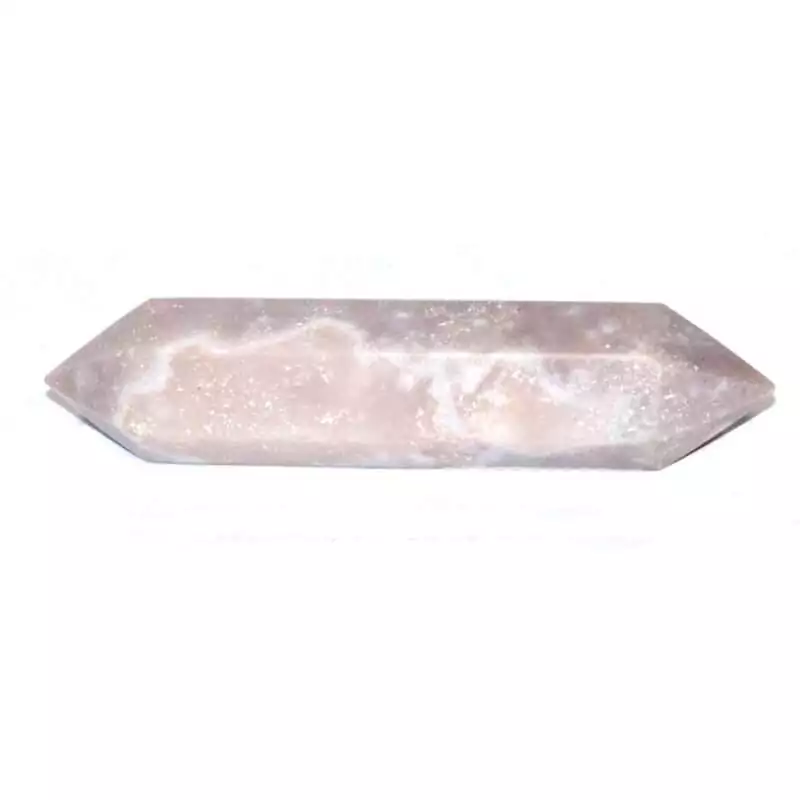
- Material: Pink amethyst (quartz)
- Shape: Double-terminated point, with a tip at each end
- Length: 2-3 inches (about 5 to 7.5 cm), sizes vary
- Finish: Polished
- Color: Soft pink and lilac-grey with white glittering patches
- Quantity: Single piece
- Mohs Hardness: 7
Pink Amethyst: A Newer Variety of Quartz
Pink amethyst is quartz, silicon dioxide, and it rates 7 on the Mohs scale like the rest of its family. Its color sits between lilac and rose, and iron is part of what produces it, as iron is in purple amethyst. A 2020 article in Mineralogical Record by Rainoldi, Rossman, Di Martino and Oteiza describes it as a new color variety of quartz, which makes it one of the youngest names in the crystal trade. Amethyst itself has a much older story. Its name comes from the Greek amethystos, meaning not intoxicated, and a Greek legend tells of Bacchus turning a maiden into clear crystal and then staining the stone purple with wine. Dealers sell pink amethyst as geode pieces and freestanding towers, and the crystals that line a geode point inward from its walls, each ending in a tip. Pink amethyst itself has no long folk history, so the associations below come from modern crystal practice and from amethyst in general.
This piece is a double-terminated point, which means it comes to a tip at both ends. Mineral glossaries define a doubly terminated crystal as one with a complete termination on both ends, and the piece is a long, faceted prism that tapers in both directions, with the two tips of similar shape and length. Its length runs from 2 to 3 inches, about 5 to 7.5 cm, so it lies easily in the palm of a hand. The body shows soft pink and lilac-grey in several shades, from dusty rose in some areas to cooler grey-violet in others. The color is closer to a pale lilac-rose than to the deep purple most people picture for amethyst. White patches scattered along the sides carry a fine glitter that catches lamplight, and the polished facets give the whole piece a satiny sheen. Natural stone varies, so each point has its own length and its own pattern of patches.
Practical Ritual Applications
Crystal guides link amethyst with the crown chakra and secondarily the third eye, and those associations suit a point you keep near your reading space. Lay it across the top of your Tarot cloth, or rest it beside your deck while you shuffle. Hold it between your palms for a minute of quiet before you draw a card, or set it on your desk to catch the light while you journal. A pink candle in a safe holder beside it gives a small altar a soft color scheme. Arrange a few small stones around it for a simple display, or tuck the point into a cloth pouch when you travel to a reading. For more points in other stones, browse my crystal points collection.
How to Use a Pink Amethyst Point
Three steps for giving the point a place in your space.
- Look Closely in Daylight
Take the point to a window and turn it slowly between your fingers. Notice where the pink deepens and where it fades to lilac-grey, and find the white patches that glitter when the light moves. Spend a minute on one tip and then on the other. Choose the side you like best to face forward when you display it.
- Hold It for a Quiet Minute
Sit with your elbows on a table and cradle the point between your palms. Breathe slowly and feel the weight and the cool, smooth facets. When you are ready, set the point beside your deck and draw your first card, or open your journal and write your first line. Repeat the routine at the start of each reading, and the point becomes your cue to begin.
- Give It a Resting Place
A double-terminated point has no flat base, so rest it on its side in a shallow dish lined with cloth, or seat it in a small stand. Choose a shelf or table away from the edge, where a passing sleeve is unlikely to reach it. Set the point down gently on a soft surface, and wrap it in a soft cloth when it travels.
The Tarot Fellow Standard
This point is for people who want a pale pink crystal with a clean shape. At 2 to 3 inches it fits a small altar, a reading table or a pocket pouch, and the two tips give it a balanced look from every side. Pink amethyst is a young name in the crystal trade, and I like that a piece this size lets you hold something quite new alongside older favorites such as clear quartz. If you like crystals that grow in hollows, browse my geodes, clusters and druse.
Frequently Asked Questions
No. Both are quartz, and they form in different ways. Rose quartz usually occurs as massive, anhedral stone and rarely forms well-shaped crystals. Pink amethyst grows as crystals lining geodes. A dealer adds that rose quartz gets its color from fibrous inclusions, and that the pink in pink amethyst seems to arise from the same iron-related process as the purple of amethyst.
The material described in the 2020 Mineralogical Record article comes from geodes in Patagonia, Argentina. Those geodes first appeared on the market in 2017, at a gem fair in Brazil, and dealers describe pink amethyst as a recent find. The article calls the pink crystals that line the geodes a new color variety of quartz. Several dealers name the source mine differently, so the region is the safer detail.
A double-terminated crystal has a complete termination on both ends, so it comes to a tip at each end. The Minerals.net glossary defines the term this way and illustrates it with a doubly terminated amethyst crystal, and Wikipedia describes the crystal as having natural facets on both ends. This piece is sold as a double-terminated point, with a tip at each end.
Reviews
There are no reviews yet