
Quick Specs
- Material: Goldstone (man-made glass with copper crystals)
- Shape: Pyramid
- Size: 30mm (about 1.2 inches)
- Finish: Polished
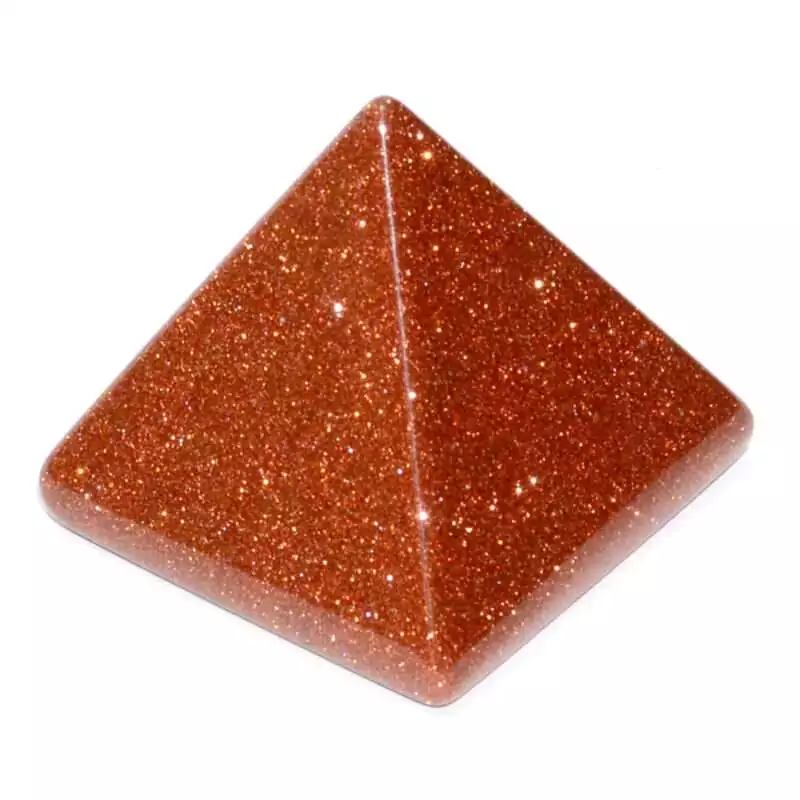
- Color: Reddish brown with gold-toned sparkle
Goldstone: Sparkling Glass From Venice
Goldstone is man-made glass with a metallic glitter, and glassmakers have produced it for centuries, with some interruptions, up to the present day. Venetian glassmakers on the island of Murano developed it, and for a long time it was called aventurine glass. That old name gave gemology three words still in use: aventurine, the green quartz that glitters with tiny flakes of mica; aventurescent, the adjective for a stone with that glitter; and aventurescence, the effect itself, a sparkle produced by many small reflective particles. Reddish brown was the original color of goldstone, and it remains the most common one. Lapidaries cut the glass into cabochons, hearts, beads, spheres, pendulums, arrowheads and small sculptures, and it is a familiar material for tumbled stones as well. Under a microscope the sparkle resolves into the triangular faces of tiny octahedral copper crystals, each reflecting light back from a different depth below the polished surface. Because the glass is made in a large heated vessel, each batch varies in how large and how bright its crystals grow, and areas with few crystals, bubbles or slag are set aside.
This pyramid measures 30mm, about 1.2 inches, a size that stands comfortably on a desk or sits in the palm of a hand. Its faces are polished to a glossy finish and meet at a single point, and the base edge is softly rounded. The color is a deep chestnut to copper red, deepest at the center of each face and lighter toward the edges, with a band of paler orange-brown around the base. Fine gold and white pinpoints are scattered across it, and they flash when the pyramid moves or when you move around it. The pinpoints are the copper crystals inside the glass, so the sparkle seems to float at several levels inside the stone. Under a lamp the glints multiply, and a bright line of reflected light runs down the ridge where two faces meet. The sparkle is dense and even across the faces in view, so the pyramid reads well from any side of a shelf, and the single point at the top gives the eye a place to rest.
Practical Ritual Applications
Crystal guides link goldstone with ambition, motivation and confidence, which makes the pyramid a natural fit for a desk or a work altar. Stand it beside your laptop or a notebook of goals and glance at it when you need a nudge to begin. Place it in the middle of a ring of orange or gold candles in their holders, or place it on a card for a project you are starting and hold it while you name the first step. A Tarot card that stands for your goal can rest beside it, if you like to pull one for the week. It also makes a small gift for someone starting a new job or a new project. For other stones cut into the same form, browse my pyramid collection.
How to Display and Care for a Goldstone Pyramid
Place it in moving light, tie it to one project, and protect the glass.
- Choose a Spot With Moving Light
Goldstone sparkles most when light moves across it, so place the pyramid where a lamp, a window or a candle in its holder changes the light through the day. Turn it slowly in your hand first, and notice which face glitters brightest from your usual seat. Set that face toward you, and give the pyramid a flat, steady surface so the base sits level.
- Set an Intention for the Piece
Pick one project, such as a job application, a new habit or a creative piece, and write it in a single line on a small card. Rest the pyramid on the card for a week. Each time you sit down to work on the project, hold the pyramid for a breath and say the first action out loud. When the week ends, write a fresh line or choose a new project.
- Protect the Glass
Goldstone is glass, and glass fractures in curved, shell-like chips when it takes a hard knock. Set the pyramid on a felt pad, a cloth or a small dish, away from the edge of a shelf, and keep it out of reach of pets and small children. Wipe it with a soft cloth when dust builds up. Wrap it in a cloth when you carry it, so it travels without bumping against keys or other stones.
The Tarot Fellow Standard
I stock this pyramid for people who like a stone with a story, and goldstone has a good one: Venetian glassmakers, copper crystals and a name that gave gemology some of its vocabulary. The material is man-made glass with copper crystals inside. At 30mm it fits a shelf, a desk or a corner of an altar, and the polish shows the sparkle from every side. Ambition and confidence are crystal-lore meanings, useful as prompts for your own goals. For more stones cut into points and towers, browse my points, generators and obelisks.
Frequently Asked Questions
Glassmakers melt glass at a high temperature with copper compounds, and the copper dissolves into the melt. The batch then cools very slowly, which gives copper ions time to find one another and grow into tiny octahedral copper crystals, and slower cooling grows larger crystals. The glass itself is colorless, and the reddish-brown color comes from light reflecting off the copper crystals inside it.
All three glitter, so they are often confused. In goldstone the sparkle comes from copper crystals of similar size spread evenly through glass, and the crystals are readily visible under 20x magnification. The copper flecks are coarse and dispersed through the glass in an unnaturally uniform manner, and that even spread helps separate goldstone from aventurine quartz and sunstone, where the sparkling inclusions are natural mineral flakes.
Yes. Reddish brown is the original and most common color, and goldstone is also made in blue, green and purple. In those versions the color belongs to the glass itself: cobalt makes blue, chromium makes green and manganese makes purple. The reddish-brown version gets its color from reflections off the copper crystals inside colorless glass.
Reviews
There are no reviews yet