
Quick Specs
- Stone: Turquoise
- Shape: Pyramid
- Size: 25-30mm (about 1 inch wide and 1 inch tall)
- Finish: Matte, fine-grained surface
- Color: Pale mint to aqua-green with rust-orange patches
- Mohs Hardness: 5 to 6
Turquoise: A Copper Phosphate Stone Cut Into a Pyramid
Turquoise is a porous, semitranslucent to opaque compound of hydrated copper and aluminum phosphate. It forms in dry regions where copper-rich groundwater reacts with aluminum- and phosphorus-bearing minerals and fills cracks and cavities in the surrounding rock. The colors run from dull and grass greens to a bright, medium-toned sky blue. Some of the host rock usually remains in the stone as matrix, which shows up as brown or tan markings or as fine webbed veins. Turquoise rates 5 to 6 on the Mohs scale, which is fairly soft, and the lower the hardness, the greater the porosity. People have prized it for at least two thousand years. The Nishapur district of Iran is the traditional source of the finest blue and has supplied turquoise for at least 2,000 years. Pre-Columbian peoples mined it in New Mexico, and Pueblo, Hopi, Zuni and Navajo jewelry traditions feature it today. It is also a traditional December birthstone.
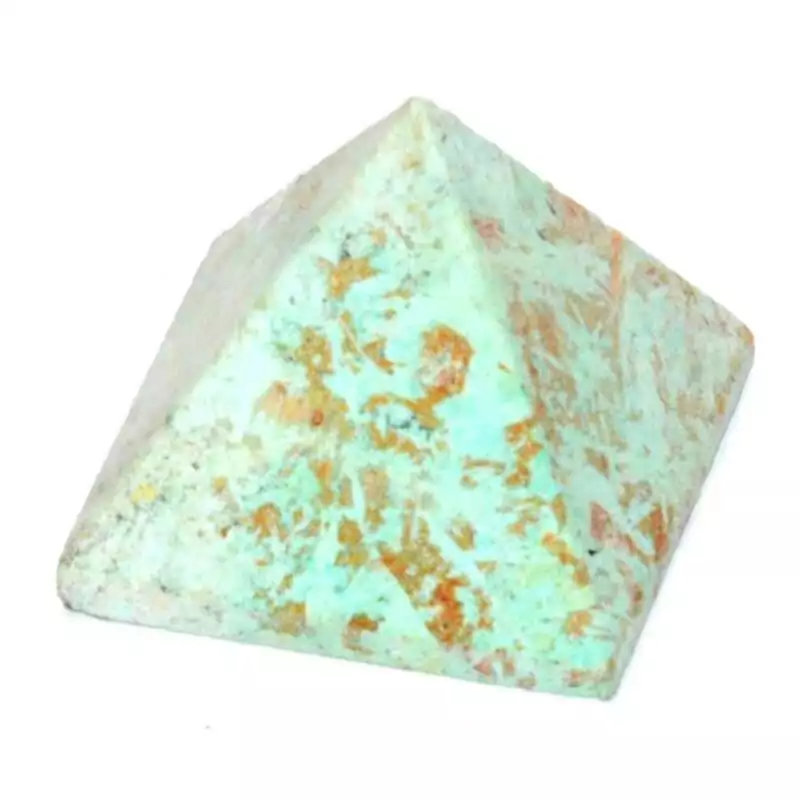
This pyramid measures 25 to 30mm, close to an inch across the base and an inch in height, small enough to sit on a desk edge, a shelf or the palm of your hand. The stone is a pale mint to soft aqua-green with rust-orange patches and streaks scattered across the faces, and pale grey-white areas gather near the edges. The faces are flat, the edges run straight from the base to the apex, and the surface has a fine, matte finish with a slightly grainy look that gives the stone a soft, chalky appearance. A pyramid stands on its base and points upward, so it takes up little room and gives the eye a single point of focus. In modern crystal practice, turquoise is associated with the throat chakra and with communication, which suits a stone kept near a place where you write, speak or read aloud.
Practical Ritual Applications
Stand the pyramid beside the journal or laptop where you draft letters, notes and difficult messages, and let it mark the spot where you put your words on paper. Keep it near your reading table so that it sits within sight as you voice a spread aloud. A pale blue or white candle in a holder beside it makes a quiet corner for a few minutes of preparation before a conversation. Hold it in one hand for three slow breaths before you speak in a meeting or on a call. Set it at the center of a small ring of tumbled stones if you want a focal point on a tray. At this size several small pyramids sit comfortably together on one shelf, and my pyramid collection holds other stones cut in the same shape.
How to Use a Turquoise Pyramid
Three steps for giving a small stone pyramid a job on your desk or altar.
- Look Over the Stone
Turn the pyramid in good light and look at each face, each edge and the apex. Notice where the mint-green deepens, where the rust-orange patches gather and where the pale grey-white areas sit. Hold the pyramid by its sides while you look, since the corners are the likeliest places for a chip. A minute of attention shows you how the colors change from one face to the next.
- Choose a Dry, Shaded Spot
Set the pyramid on its base on a flat, stable surface, such as a desk, a bookshelf or the center of an altar, where nothing will knock it. Choose a place away from sinks, humidifiers and windows that get long hours of direct sun. Leave a little space around it so the shape reads clearly, and pair it with whatever you want to bring to mind: a notebook, a candle or a card.
- Hold It Before You Speak
When you have something to say that matters, pick up the pyramid with one hand and hold it by the sides. Breathe slowly, counting five breaths, and feel the edges and the fine, grainy surface of the stone. Think of the first sentence you plan to say. Set the pyramid back on its base, then begin to speak or write while it stays in sight.
The Tarot Fellow Standard
I stock this pyramid for people who like turquoise in a small, upright shape: a pale mint-green stone with rust-orange patches that sits well on a shelf, a desk or an altar. At 25 to 30mm it takes little room, and the colors vary from one face to the next. The throat chakra and communication associations come from modern crystal practice, and they work best as themes you choose to explore. Browse my communication stones for more stones with the same theme.
Frequently Asked Questions
Treatment is common. GIA notes that coarse, porous turquoise is usually treated to make it smoother, shinier and more marketable. Methods in the trade include waxing or oiling, stabilization with epoxy, plastic or water glass, dyeing, and reconstitution, in which turquoise is bonded with resin into blocks. Light waxing has long been accepted, and some purists consider dyeing fraudulent. Dyed howlite and magnesite are common imitations.
Matrix is host-rock material left inside the stone. According to GIA, limonite produces dark brown markings and sandstone produces tan ones, and matrix in thin, web-like lines is called spiderweb matrix. Another reference describes the mother rock as brown or black veining. Matrix varies from stone to stone, and it is part of what gives each piece of turquoise its own look.
Keep it dry. Turquoise is porous, so it can take up liquids, and perfume, cosmetics, skin oils and most cleaning fluids can attack the finish or change the color. One crystal reference lists it as unsafe for water and recommends a dry cloth. Prolonged sunlight can discolor or dehydrate it, and storing it apart from harder stones avoids scratches. A pyramid on a dry shelf out of direct sun meets all of these.
Crystal guides pair turquoise with the throat chakra, the center linked with communication in the modern seven-chakra system, and with the zodiac sign Sagittarius. The chakra idea itself comes from Indian traditions, where texts count from four to eight centers, and the seven-chakra scheme reached the West through the Theosophists in the 1880s. Treat the pairing as a modern crystal-lore theme.


Reviews
There are no reviews yet