
Quick Specs
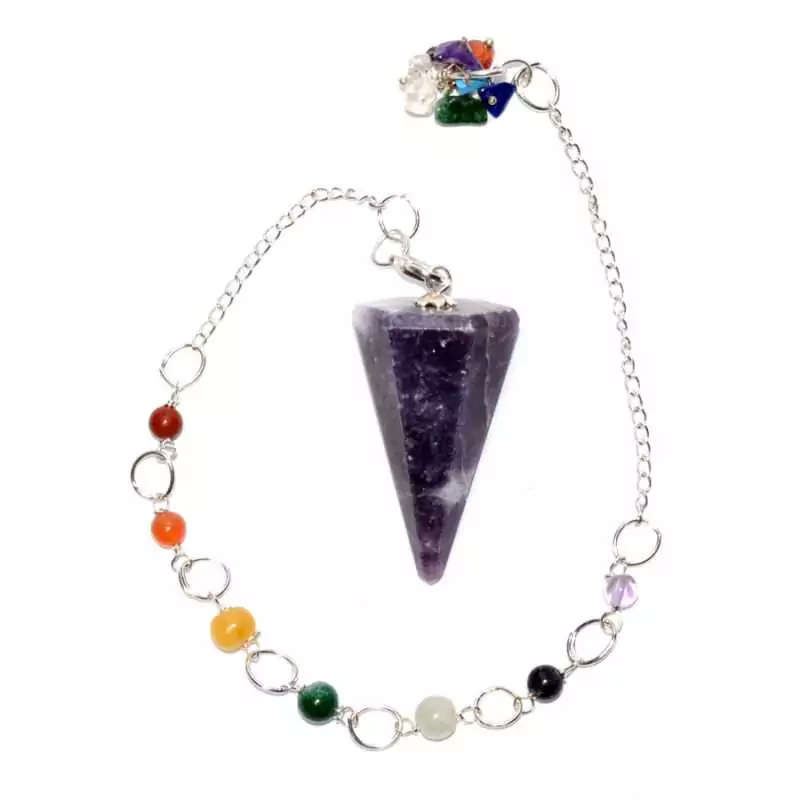
- Type: Pendulum with beaded chain
- Stone: Lepidolite
- Shape: Six-sided faceted point
- Chain: Silver-toned, with seven small round beads
- Accent: Cluster of colored chips at the far end of the chain
Lepidolite: A Glittering Mica Cut Into a Pendulum
Lepidolite is a mica, a layered silicate that splits cleanly in one direction, and that structure explains the glitter: fine flakes at the surface catch the light with a pearly to glassy sheen. Manganese produces its pink, red and purple shades. Because lithium is one of the last elements to crystallize from a cooling magma, lepidolite collects in late-stage deposits called pegmatites, greisens and hydrothermal quartz veins, usually as small pods. Well-known sources include Minas Gerais in Brazil, Madagascar, Manitoba in Canada, the Ural Mountains of Russia and American states such as California and Maine. Lepidolite is used as crushed flake mica and in glass and enamel, and as a gem material it is cut into cabochons, beads, tumbled stones and ornamental pieces like this pendulum. The stone is soft, rated about 2.5 to 3 on the Mohs scale, and its perfect cleavage makes it flaky, which is why it is best stored apart from harder gems and jewelry.
This pendulum is a six-sided point: six flat faces taper from the top to a blunt tip, and a small metal cap and clasp at the top attach the chain. The stone is a deep violet with fine glittering flecks and a few paler patches, and each face throws the light differently as the point turns. Six faces give the point a defined edge at every corner, and the tip hangs plumb when you hold the chain still. The chain is silver-toned, with open metal rings linking the beads. Seven small round beads sit along it, in red, orange, yellow, green, pale green, near-black and pale lilac, the same count as the main chakras of the modern Western system, and a cluster of chips in assorted colors hangs from the far end. In modern crystal practice, lepidolite is associated with the crown chakra and the zodiac sign Libra, and the seven beads give that association a row of colors to sit beside.
Practical Ritual Applications
Use the pendulum for short yes-or-no questions at a reading table, resting your elbow on the surface and letting the point hang a few inches above a blank page or a printed mat. Between sessions, lay the chain in a curve on a cloth so the seven beads read in a row, with the violet point resting at one end, and the piece becomes a small altar display. Some people keep a notebook beside it and write the date, the question and the swing, which makes a pattern easy to review later. If you want to read further on dowsing and pendulum work, browse my pendulum and dowsing books. When you finish, coil the chain loosely in a small dish or pouch so the beads and chips stay untangled.
How to Use a Lepidolite Chakra Pendulum
Three steps take you from first hold to a clear question.
- Settle In and Take Hold
Sit comfortably and rest your elbow on a table so your forearm is steady. Pinch the chain between your thumb and index finger a few inches above the stone, with just enough pressure to keep it from slipping. Let the point hang still, breathe slowly, and wait until all motion stops. Keep the beads and the cluster of chips clear of your hand so they stay free of your sleeve.
- Calibrate With Answers You Know
Ask a question whose answer you know is yes, and note which way the pendulum moves. Then ask one whose answer you know is no, and note the new direction. Those two directions become your yes and no for the session. Repeat this check each time you sit down, because the directions can change from one session to the next.
- Ask One Clear Question
Phrase a single question that has a definite answer, then hold the pendulum still and wait for it to begin moving. Write down the question, the swing and the date, then stop and set the pendulum down. Ask the next question only after the point has settled again. A lepidolite point is soft, so keep the swing small and avoid knocking it against the table.
The Tarot Fellow Standard
I stock this pendulum for people who want a pointed stone with some sparkle on a chain that carries the seven-chakra count in its beads. The lepidolite gives the point its glitter, and the chips at the far end add a small touch of color to a desk or altar display. A pendulum is a focus for your own attention, and the way you use it is yours to shape. Browse my stone pendulums to compare other stones and shapes.
Frequently Asked Questions
Yes. Lepidolite is the most common lithium-bearing mineral and a minor ore of lithium, and rubidium and cesium are sometimes recovered from it as by-products. The metal is part of the stone's mica structure, so lithium sits in the crystal itself. The mineral has been mined for it, though most lithium today comes from South American brines.
Small hand movements, many of them unconscious. Psychologists call this the ideomotor phenomenon: tiny motions triggered by a thought or mental image, often without the person noticing. A hand-held pendulum amplifies those motions, and people who use one read the swing as a response to the question they hold in mind. Resting your elbow on a table keeps the movement small and the start steady.
Keep it apart from other gems and jewelry. Lepidolite is soft, about 2.5 to 3 on the Mohs scale, and it cleaves into flakes in one direction, so harder stones can scratch it and a knock can chip it. A small pouch or a cloth-lined dish works well, with the chain coiled loosely beside the point. For cleansing, a crystal encyclopedia lists moonlight and sound for this stone.

Reviews
There are no reviews yet