
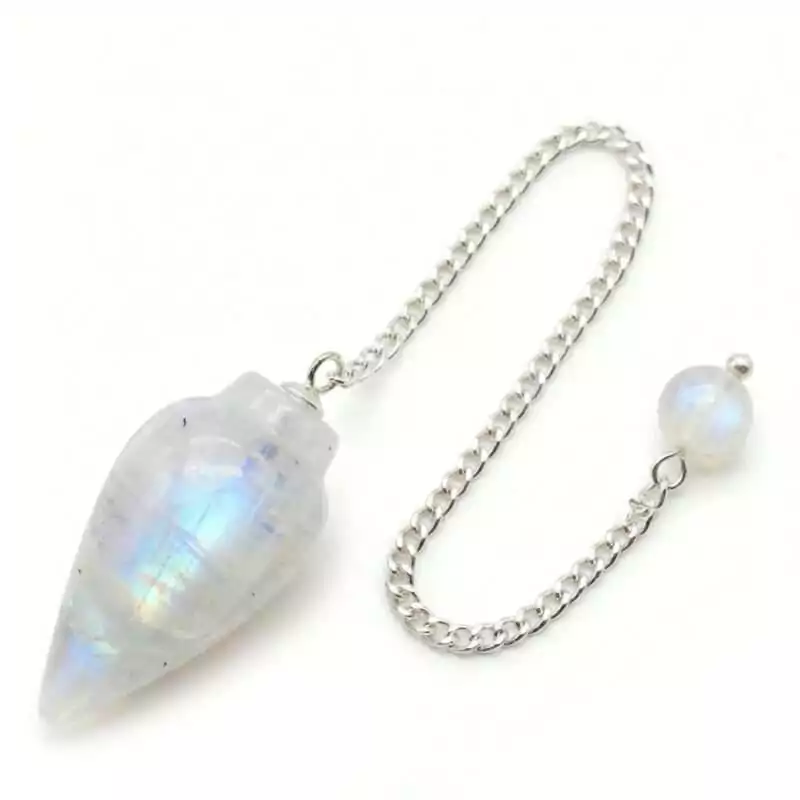

Quick Specs
- Stone: Rainbow moonstone (white labradorite / plagioclase feldspar)
- Shape: Conical bob
- Dimensions: 1.7 x 1.3 x 0.3 in
- Chain: Included
The Stone That Wears Someone Else’s Name
I want to give you an honest introduction to this stone before you fall in love with a legend that isn’t quite accurate. What the gem trade calls “rainbow moonstone” is not orthoclase moonstone. It is white labradorite, a plagioclase feldspar sitting at roughly the calcium-rich end of the albite-anorthite series. The two are mineralogically distinct. True moonstone is an orthoclase feldspar whose glow – called adularescence – comes from light scattering between alternating layers of orthoclase and albite inside the stone. White labradorite produces its flash through a different mechanism called labradorescence: light refracting through alternating twinned crystal layers of anorthite and albite. The result looks similar and is just as striking, but the physics and chemistry are not the same.
The trade name “rainbow moonstone” stuck because the stone earns it visually – that rolling blue-white flash genuinely resembles moonlight on water. And culturally, the moonstone lineage it borrows from is ancient and deep. In Hindu tradition, the stone known as Chandrakanta (“beloved of the moon”) has been sacred for millennia. Ancient Sanskrit texts describe it as carrying the cool light of Chandra, the moon deity, and associate it with the Third Eye and enlightened perception. Practitioners placed it on yellow cloth during specific lunar phases to draw blessings and protection on travelers, pregnant women, and those seeking intuitive clarity. In Wicca and broader modern pagan practice, moonstone and its labradorite lookalike both carry associations with the feminine divine, lunar cycles, and the kind of receptive awareness that makes divination work feel possible.
As a pendulum, the conical bob shape earns its reputation for a specific reason: the pointed tip gives your eye a clear reference point to read swing direction, while the mass of the stone provides enough inertia for smooth, readable arcs rather than jittery micro-movements. The ideomotor effect – the well-documented phenomenon in which focused attention produces tiny, unconscious muscular movements – is what actually moves a pendulum. The stone does not move on its own. What it does is give your hand something weighted enough to translate those micro-movements into legible swings, and give your mind a ritual anchor that quiets the mental noise long enough to hear whatever signal you’re looking for.
How to Use a Rainbow Moonstone Pendulum
A simple three-step approach to get accurate, readable responses from your rainbow moonstone pendulum.
- Set Your Intentions
Hold the pendulum chain between your thumb and forefinger, letting the stone bob hang freely. Take a slow breath and state aloud what you want to learn. Ask the pendulum to show you a 'yes' motion, then a 'no' motion.
- Calibrate the Swing
Once you have your baseline motions, hold the pendulum still above your palm or a flat surface. Ask a question you already know the answer to – like your own name – and confirm the swing matches your calibrated response.
- Work with Lunar Timing
Use the pendulum on or around the full moon for clarity readings and the new moon for intention questions. Keep sessions brief – 15 to 20 minutes – so your focus stays sharp and your arm does not fatigue.
The Tarot Fellow Standard
One thing I hear from customers who are new to labradorite-family stones: “My flash disappeared – is the stone defective?” It is not. Labradorescence is angle-dependent by nature. You are looking at light refracting through internal crystal layers, and those layers only catch the light from specific directions. Turn the stone slightly, shift your light source, and the blue-white flash reappears. Every stone in this family behaves this way. Some pieces flash heavily at a 45-degree angle; others prefer direct overhead light. Part of working with this stone is learning its particular sweet spot – which, honestly, is part of the appeal.
Natural color variation is also real and expected. White labradorite ranges from near-transparent with a strong blue flash to milky white with softer, more diffuse color. No two pendulums will look identical under the same light. What you receive will be its own piece, not a catalog rendering.
If you are building out a divination practice, you may also want to explore our full pendulum collection for other stones and styles, or browse the broader crystals and gemstones collection for companions to work alongside this piece.
Frequently Asked Questions
No. Rainbow moonstone is white labradorite, a plagioclase feldspar. True moonstone is orthoclase feldspar. The trade name stuck because of its lunar glow, but the optical effect is labradorescence, not adularescence.
The blue-white flash is labradorescence – light refracting through alternating mineral layers inside the stone. Angle and light source determine whether those layers catch the light. This is normal and not a defect.
Full moon phases suit clarity and release work. New moon phases suit intention-setting and fresh questions. That said, the pendulum works any time – lunar timing is a ritual layer, not a requirement.
Wipe it clean with a soft dry cloth. Avoid prolonged water exposure, as it can dull the polish over time. Recharge the stone by placing it on a windowsill under moonlight or beside a piece of selenite overnight.

We are getting to know one another. It already picked it’s pouch. Wonderful product. Thank you!!
I love the pendulum, but it broke