
Quick Specs
- Material: Mookaite (silicified radiolarite, sold as mookaite jasper)
- Shape: Sphere
- Diameter: 40mm (about 1.6 inches)
- Finish: Polished
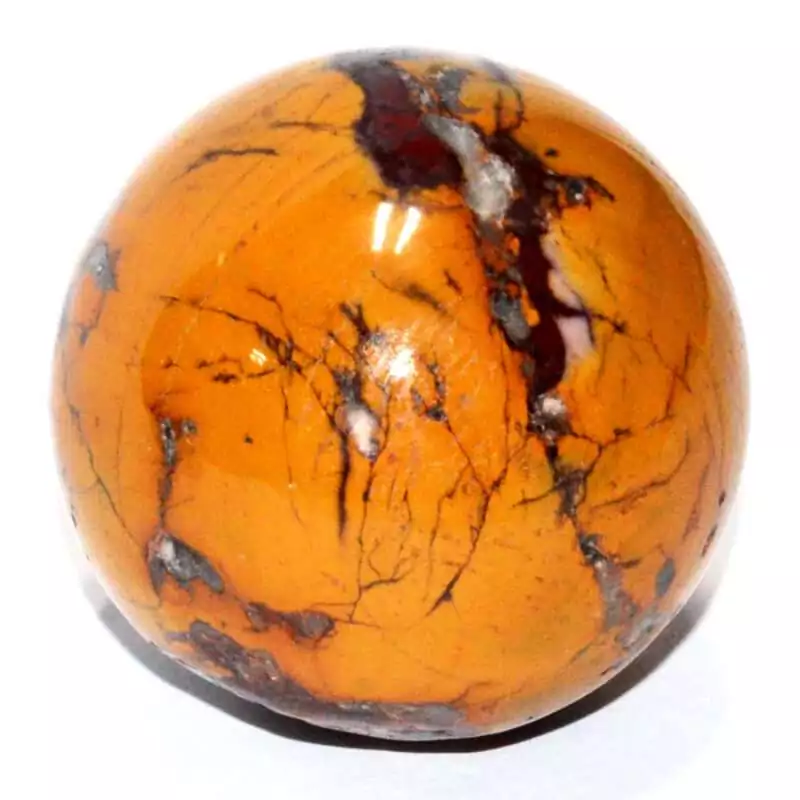
- Color: Golden orange with burgundy, cream and grey patches
Mookaite: A Stone Built From Ancient Sea Life
Mookaite is a rock made from the glassy skeletons of tiny sea creatures. Radiolarians are microscopic, plankton-like marine organisms that build intricate skeletons of silica, and when they died their remains rained down onto the seafloor of a shallow ancient sea as a siliceous ooze. During the Cretaceous period that ooze compacted, lost its water and recrystallized, and silica carried in groundwater cemented it into solid stone. Geologists call the result a radiolarite, and mookaite is a local variety of one such formation, the Windalia Radiolarite of Western Australia. Its colors range through mustard yellow, burgundy red, cream, white and muted purple, and bands, patches and swirls give each piece a mapped look. Mookaite is used as an ornamental stone and in jewelry, and a ball like this one turns a piece of that ancient sea floor into a pattern you can hold. Because it is built of microcrystalline quartz, mookaite sits in the same silica family as jasper and chalcedony.
Golden orange is the first color you see on this sphere, a warm, saturated shade close to amber. Patches of deep burgundy with creamy white centers gather near the top, grey and pale patches sit along the lower edges, and a web of fine dark hairlines wanders across the orange like cracks in old glaze. The grey patches look finer-grained and slightly duller than the orange around them, and the orange itself takes a bright polish that sends window reflections sliding across the surface as the ball turns. The sphere fits in one palm and rests securely on a stand. Every mookaite sphere carries a different map of color, and this one leans heavily toward orange, with its darkest passages gathered near the top and along one side. Turning the ball slowly brings new combinations into view: a burgundy patch beside a cream one, a hairline that ends at a grey island, a stretch of clear orange. The warm palette suits a shelf of earth-toned stones, plants and wooden things.
Practical Ritual Applications
Crystal guides connect mookaite with grounding and stability, and its earthy golds and reds suit that theme. Place the sphere on a stand beside a yellow or orange candle in its holder, and spend a few minutes holding it before you start a task that needs patience. Roll it slowly between your palms while you think through a plan, or set it in front of a Tarot spread that asks about your next steps so the colors give your eyes a place to rest. On a desk it works as a quiet paperweight for a list of the week’s goals. A small sphere also suits the center of a grid of tumbled stones. For other stones that crystal guides associate with grounding, browse my grounding and earth energy stones.
How to Display and Use a Mookaite Sphere
Light it from the side, count its patches, then wipe and wrap it.
- Choose a Warm Spot
Pick a shelf or desk where light reaches the sphere from the side, because angled light brings out the depth in the orange and burgundy. Seat the ball in a ring stand or a small cup of folded cloth, a hand-width from the edge, and test it with a light touch. Keep the setup out of reach of pets and young children.
- Trace the Pattern
Turn the sphere slowly in your palms, counting how many separate burgundy patches you can find. Count the cream patches next, then the fine dark hairlines. When the count settles, set the sphere down and write one line about the task in front of you. The counting gives your attention an anchor, and the page records where you started.
- Wipe and Store
Dust the sphere with a soft cloth. A gemstone dictionary lists hydrofluoric acid as the only chemical to avoid, and calls the stone otherwise easy to handle. When you store or travel with the sphere, wrap it alone in soft cloth so the polish stays free of scratches from harder stones.
The Tarot Fellow Standard
I stock this sphere for people who enjoy a stone with a clear story: a rock built from radiolarians, hardened in a Cretaceous sea and polished into a ball you can hold. The golden orange adds warmth to a shelf of blue and purple stones, and the 40mm size keeps it easy to place. Grounding is a crystal-lore theme that suits the earthy palette, offered as a prompt for your own reflection. Other spheres to compare are in my crystal balls and spheres collection.
Frequently Asked Questions
Mookaite is sold as mookaite jasper, while geologists and gem dictionaries classify it as a silicified radiolarite, a sedimentary rock built from the silica skeletons of radiolarians. The two names overlap because the rock holds more than one form of silica: several references list jasper, chert and chalcedony among its parts.
Mookaite comes from Western Australia. It is quarried along Mooka Creek in the Kennedy Range, about 180 km east of the coastal town of Carnarvon, and the stone takes its name from the creek. The rock is a local variety of the Windalia Radiolarite, a Lower Cretaceous formation in the region.
Most mookaite holds only the chemical remains of the radiolarians that built the rock, in the form of silica. Occasionally a piece also preserves impressions of larger sea creatures such as ammonites and belemnites, left as molds and casts when their shells dissolved and silica filled the hollows.


Reviews
There are no reviews yet