

Quick Specs
- Type: Stick incense holder
- Size: 5 inches
- Material: Resin
- Shape: Round
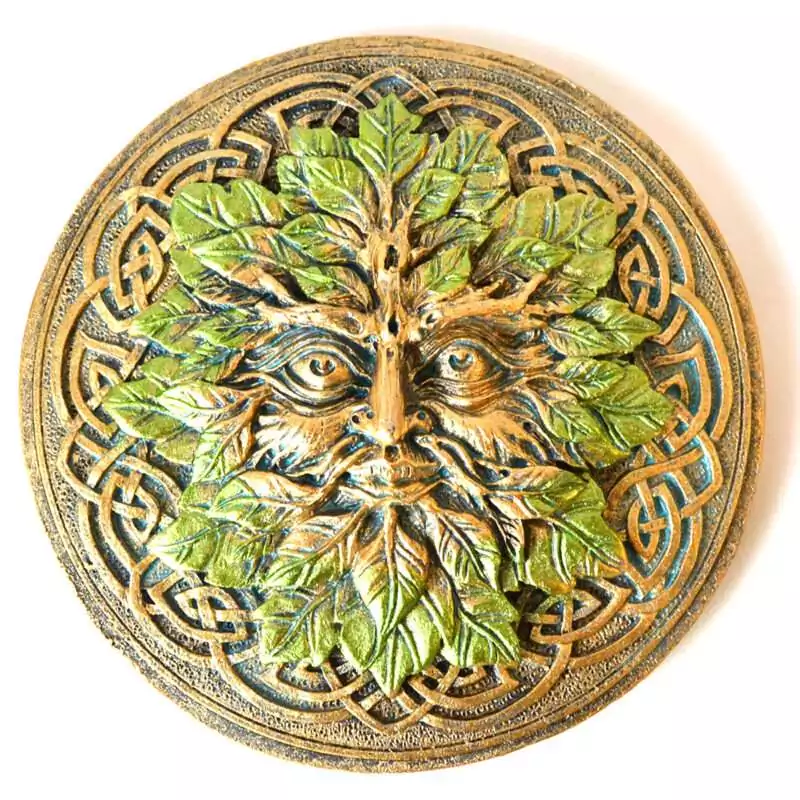
- Design: Treeman face of leaves and branches, ring of interlaced knotwork
- Finish: Gold-bronze with blue-green in the recesses, green leaves
A Bronze-Gold Treeman Among Green Leaves and Knotwork
A man’s face looks straight out from the middle of the disc. His eyes are wide and round, set under heavy brows that are really branches, and the bridge of his nose runs down the center like a small trunk. Fine wrinkles fan out from the corners of the eyes, and the mustache and beard are modeled with short curved strokes. Leaves grow where hair and beard would be. Bright green ones fan out above the brows, press along the cheeks, and gather in a long cluster beneath the mouth, each with a raised central vein and a curved edge. The leaves have a metallic green sheen, and the rest of the face is gold-bronze, with blue-green worked into the recesses as though verdigris had settled into the creases around the eyes and between the leaves. Around the face, a ring of interlaced knotwork loops in gold on a blue-green ground, and two narrow raised rims enclose it. The outer edge is a textured, speckled bronze that frames the whole relief. The holder is cast in resin, and its round shape measures 5 inches.
A face built from foliage is an old image in European carving. Churches and cathedrals carry them on capitals, corbels, roof bosses, and misericords, and the motif is known as the foliate head or the Green Man. It appears on buildings across Europe and beyond, and heads of this type first turned up in England in the early twelfth century, derived from French examples. The face is almost always male and usually shown in relief, as it is here. Scholars read the figure in different ways, most often as a symbol of rebirth, and Richard Hayman, whose work the Library of Congress cites, places the British examples within Christian iconography. The border on this holder draws on a second old tradition. Interlaced knotwork is used extensively in the Celtic style of Insular art, the Book of Kells carries it on almost every folio, and the earliest true knotwork in the Celtic manner appears in a seventh-century gospel book fragment from northern Britain. Leaf face and knotwork share one disc here.
Practical Ritual Applications
Seat a stick of incense in the holder and set the disc on a shelf, a windowsill, or a table where plants already sit. Green leaves and bronze-gold read well beside a fern, a bowl of seeds, or a stack of nature books, and a green or blue cloth under the holder picks up the tones in the knotwork. Rebirth is the usual reading of a leaf-faced head, so the holder suits a spring altar or a garden corner indoors. Between sticks, the relief keeps its place as a small piece of decor, with the face catching light from a window or a lamp. My stick incense collection has plenty of scents to burn in it, and a woody or green scent echoes the leaves on the face.
How to Burn Stick Incense in the Treeman Holder
Set it up, light the stick, and let everything cool before you touch it.
- Give It a Stable, Fire-Safe Base
Set the holder on a flat, heat-resistant surface such as a ceramic tile or a metal plate, where no one can knock it over. Keep curtains, clothing, paper, and plants well away from the disc, and keep it out of reach of children and pets.
- Seat and Light the Stick
Place a stick in the holder, hold a flame to the tip until it glows, then shake the flame out. Stay in the room while it burns. Fire services advise never leaving burning incense unattended, and a lit stick that tips toward leaves, paper, or fabric can start a fire.
- Put It Out and Wait
Check that the stick is completely extinguished before you leave the room or go to bed. Ash and holders can stay hot after use, so give both time to cool before you handle the disc, and clear the ash only when it is cold.
The Tarot Fellow Standard
I stock this holder because it puts a leaf-faced Treeman and a knotwork border on one 5 inch resin disc, and both carry fine detail: wrinkles around the eyes, veined leaves, and loops of interlace around the edge. It suits a nature-minded shelf, a spring altar, or a Celtic-themed corner of a room, and it burns stick incense. If you like interlace and old European imagery, my Viking and Celtic collection has more pieces to set beside it, from jewelry to home decor.
Frequently Asked Questions
Scholars disagree. Lady Raglan's 1939 article in Folklore linked the carvings to pre-Christian fertility rituals, and the idea spread widely. Later writers find no evidence for a link to a pagan nature deity, and Richard Hayman, whose work the Library of Congress cites, argues that Green Men in Britain belong to Christian iconography. Most surviving carvings are on churches and cathedrals, and the figure is usually read as a symbol of rebirth.
Celtic knotwork is a decorative interlace used extensively in the Celtic style of Insular art. Most designs are endless knots, with bands that pass over and under one another and never end. Interlace patterns first appeared in the late Roman Empire, and the earliest true knotwork in the Celtic manner is found in a seventh-century gospel book fragment from northern Britain. The Book of Kells carries knotwork in almost every folio.
A stick of incense has a bamboo core coated with incense material. A holder keeps it upright and catches what falls from it. Stick holders come in wood, metal, and ceramic, and a common design is a plate perforated at one end to hold the stick and catch the ash. Fire services advise a heat-resistant holder designed to collect falling ash, set on a stable surface.

Reviews
There are no reviews yet