
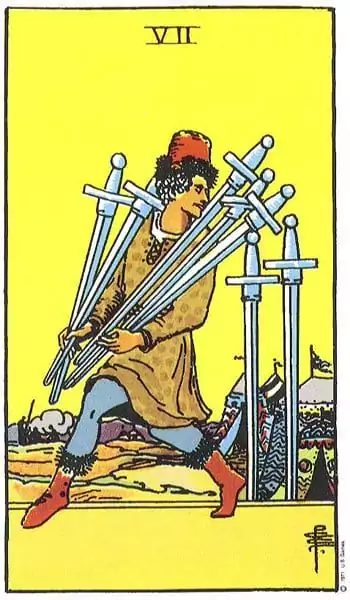
Seven of Swords
Card meaning
The story of the Seven of Swords is one of intrigue, espionage, and theft. It is full of deception. The perspective of the card clarifies whether you are the perpetrator or are the victim.
Stealing is never a good idea, but it’s especially stupid when you are stealing from someone with the means to come after you. Such is the story shown on the card—a young man who thinks he is smarter than an army, goes into their camp and steals their swords.
He may even think he is doing something morally right by avoiding a war, but deception and thievery are never the way to get what you want. The army has the power to pursue the thief, most certainly will, and the consequences can be long lasting, if not brutal.
When the Seven of Swords appears in a reading, you may think you are smart enough to get away with something, but this is not the case. Even if your intelligence tells you the moral high ground is yours, never stoop to illegal activity. If you feel you have to put your ethics at risk to succeed, now is a good time to reevaluate your ethics, or revise your goal. With this energy in your life, you must also watch yourself, because there is deception around you, lying and trickery if not outright theft, and you are playing the part of the victim. If this is the case, make sure you don’t let your emotions or ambitions get in the way of the truth. Remember, the person who is deceiving you believes they are smarter than you. Prove them wrong.
Frequently Asked Questions About Seven of Swords Tarot Card
The Seven of Swords is a card of deception, theft, and strategic cunning. It warns that clever schemes — whether yours or someone else’s — carry serious consequences when they unravel.
In shadow, the perpetrator is exposed. You may think you are smart enough to get away with something, but the truth surfaces. The need to put your ethics at risk to succeed signals a wrong path.
The Sevens are the major obstacle of their suit. The Fool, overambitious after the Six’s escape, tries to outsmart opposition through trickery — and learns that deception carries brutal consequences.
Tarot cards are too layered and contextual to reduce to yes or no. For that, try a pendulum or dowsing rods. Here it cautions: if you must deceive to succeed, revise your goal. A ‘yes’ built on dishonesty will not hold.
In love, this card flags dishonesty — secrets, hidden motives, or outright lies. One partner may be playing a role while concealing the truth. Clarity requires confronting what is being withheld.
The card’s perspective shifts based on your position. As perpetrator, you scheme and risk exposure. As victim, someone around you is deceiving and believes they are smarter than you. Prove them wrong.
Rarely — it can indicate strategic thinking or tactful diplomacy. But the card’s core energy is deception, so any positive reading requires honest self-examination about your actual motives.
At work, watch for colleagues taking credit for your ideas or using unethical tactics to get ahead. If you feel pressured to cut corners or lie, the card says to revise your goal instead.

