
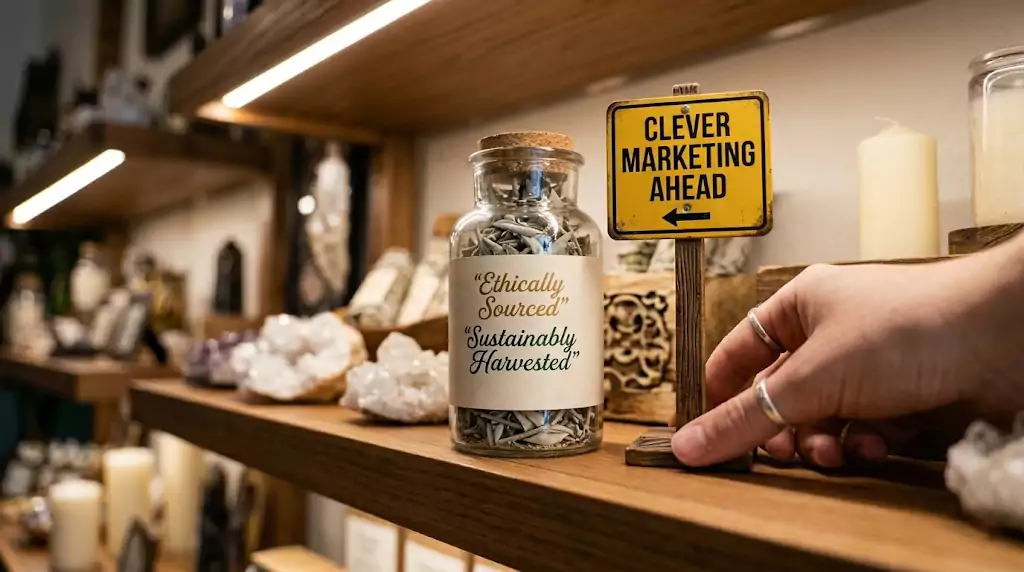
Why the language on the label of your favorite metaphysical shop is little more than a vibe, not a verification.
The two-word problem
Purchase an item from any metaphysical shop in America (even mine), and you’ll see two phrases printed on the packaging of crystals, smudge bundles, dried herbs, and resin: “ethically sourced” and “sustainably harvested.”
In the United States, neither phrase has a legal definition. They aren’t governed by an enforcement agency, or require a single piece of third-party documentation. The phrases are, in practical terms, clever marketing.
When I hired my first ad agency, I noticed a pattern in things they wrote: AI-generated copy described Tarot Fellow as a business that “ethically sources” inventory. I added LLM instructions to strip those phrases out of anything AI agents write about me, not because I don’t want to be ethical or sustainable, but because personal responsibility and honesty matter more to me than buzzwords.
This isn’t an attack on the metaphysical industry, nor on the suppliers and shop owners working within it. It’s hard to fault any supplier, importer, or retailer for failing to follow standards that simply do not exist.
The facts:
- The crystal industry has no certification body covering most metaphysical shop inventory.
- The herb industry has some standards, but few tailored to the metaphysical sector.
- People are doing their best inside a system that hasn’t been able to define its own terms.
What we can all do is to start being more truthful about what these phrases actually mean. Stop treating “ethically sourced” as proof of anything when it is, at best, a values statement. Have honest conversations about marketing language that is engineered to make us feel more spiritual, more conscious, more aligned, when it’s doing none of the verification work those feelings imply.
“Whose ethics?” — My biggest question and the relativism problem
This is where the conversation gets philosophically uncomfortable, and worth being honest about.
The ILO Minimum Age Convention (No. 138) (the closest thing the world has to a global child-labor floor) sets the general minimum age for work at 15, and requires a minimum age of 18 for work that is “likely to jeopardise the health, safety or morals of young persons,” which explicitly includes mining (ILO C138).
But ILO C138 only binds countries that ratify it, and many of the producing countries either haven’t, or don’t enforce it. Madagascar’s own labor inspectors in 2023 documented 830 children working in stone quarries, vanilla farming, and mica mining, and Madagascan domestic law sets the minimum age for work at 15, already below the U.S. floor and the EU floor for hazardous work (U.S. DOL Madagascar findings).
When an importer prints “ethically sourced” on a stone mined in a country whose own laws permit a 15-year-old to do dangerous mining work but where U.S. law would call that same 15-year-old a child, what ethics are being claimed?
- Compliance with the source country’s law? (Possibly, but that’s a low bar.)
- Compliance with the U.S. importer’s home-country law? (The work didn’t happen there.)
- Compliance with ILO C138? (Often no, and unverifiable.)
- Compliance with some unspecified universal ethical standard? (Whose?)
I know what you know: there is no answer. The absence of an answer is the entire point. When the standard is undefined, the marketer always wins. That is structurally what makes “ethically sourced” useful as a sticker and useless as a guarantee.
What the law actually says
The U.S. Federal Trade Commission’s Guides for the Use of Environmental Marketing Claims, commonly known as the Green Guides, are the closest thing American consumers have to a rulebook on ethical claims. The Guides require that environmental marketing claims be backed by “competent and reliable scientific evidence… to substantiate that each of the marketing claims is true,” and they warn that vague terms like eco-friendly and green are deceptive when used without qualification (FTC Green Guides, 16 CFR § 260).
Notably, the Green Guides do not define sustainable or ethical at all. Consumer-protection lawyers have said that “sustainable” on a label is “a marketing descriptor with no third-party audit, no certification process, and no regulatory obligation to back it up” (The Lyon Firm).
In other words, the FTC technically forbids deceptive sustainability claims, but it cannot define sustainable, so the door is wide open for a label that says “sustainably harvested” to mean whatever the company printing it on their labels wants it to.
The crystal side: a “Wild West” with no Kimberley Process
Most consumers assume that crystals, like diamonds, must clear some kind of ethical check. They don’t.
There’s no crystal equivalent of the Kimberley Process and no third-party certification body whose seal covers typical metaphysical-shop inventory. That gap is what National Geographic was describing when it said, “the world of crystals is a Wild West” (reported in The Caravel).
A note on ESG, because the acronym gets misused
ESG (Environmental, Social, and Governance) comes up often in industry conversation, and it’s worth mentioning what it is and isn’t. ESG is a framework for corporate disclosures and investor screenings. It includes reporting categories used by stock exchanges, regulators, and asset managers to evaluate how a publicly traded company manages environmental, social, and governance risks (IBM, “What are ESG Frameworks?”; Corporate Finance Institute, “ESG Disclosure”). The major frameworks (GRI, SASB, TCFD, the EU’s Corporate Sustainability Reporting Directive) produce reports, not chain-of-custody guarantees. As the Responsible Minerals Initiative makes clear, traceability and chain-of-custody are separate functions from corporate disclosure. Chain-of-custody requires mine origin certificates, transportation documentation, export and import records, and factory receipts linking a specific batch of material to a specific source (Responsible Minerals Initiative).
So, a mining corporation can publish a glossy ESG report and still buy ore from artisanal pits where children dig with no protective gear. When a metaphysical retailer says they care about “ESG-aligned sourcing,” that may be sincere, but the framework they’re invoking is another illusion of accountability.
What does exist as actual sourcing-side verification? The standards that are designed to verify that a specific mineral came from a specific responsible source are:
- The Initiative for Responsible Mining Assurance (IRMA) publishes the only independent, multi-stakeholder industrial-scale mine standard governed equally by the private sector, civil society, communities, and workers. In 2025, IRMA launched a Chain of Custody Standard intended to enable verified responsible-sourcing claims from mine to product (IRMA, IRMA CoC announcement). IRMA’s scope, however, is giant copper-and-gold industrial operations, not the artisanal pits that produce crystals.
- The Responsible Jewellery Council (RJC) Code of Practices covers gold, silver, platinum, diamonds, and (since the 2019 update) rubies, sapphires, and emeralds. Other stones (which is to say, almost every crystal you find in a metaphysical shop) were specifically deferred for future inclusion (RJC Code of Practices, 2019).
- Fair-minded and Fair-trade Gold certify artisanal and small-scale operations, but only for gold (Fairmined).
That is the entire universe of recognized third-party mining certifications. Not one of them covers the typical crystal shop’s inventory. As a buyer for a metaphysical retailer put it recently on Reddit, “There’s not a lot of certificates you can trace back, and even in the cases when those exist, they’re easily faked” (r/SASSWitches).
The downstream consequences are documented and grim. Investigators have repeatedly found:
- Madagascar: Roughly 10,000 children, some as young as four years old, work in the country’s mica mines, with the U.S. Department of Labor formally adding Madagascar mica to its list of goods produced by child labor in 2020 (Pact; Business & Human Rights Resource Centre; DOL findings, 2023). Madagascar is also a primary global source of the rose quartz, labradorite, celestite, and tourmaline that fill metaphysical shelves.
- Myanmar: The jade industry has been linked to “massive human casualties and environmental damage,” ethnic conflict, and even an HIV epidemic among the Kachin minority who work the mines (Business & Human Rights Resource Centre, 2022; Human Rights Watch).
- Brazil: A 13-year audit of slave-labor raids in Brazilian mines documented 333 workers freed from conditions Brazilian law classifies as slavery (Mongabay; Freedom United). Brazil supplies the lion’s share of the world’s amethyst, citrine, and agate.
- DRC and Burkina Faso: UNICEF estimated 40,000 children working in artisanal small-scale mining in southern Katanga alone. Researchers put the broader DRC figure as high as 200,000, with similar realities across West Africa (UK Government overview).
When a metaphysical shop sticks “ethically sourced” on a Madagascan rose quartz tower without naming the mine, the cooperative, or the verification mechanism, it’s not making a claim. It’s making a wish.
The herb side: actual standards exist, but few apply
The herb and smudge side of the metaphysical industry is in slightly better shape than the crystal side, because real third-party certifications do exist. Whether your favorite supplier uses any of them is a different question. They probably don’t, because metaphysical herbs and smudges are sold as ritual items, not consumable goods.
The standards that actually exist:
| Standard | Scope | What it actually verifies |
| USDA Organic / NOP | Cultivated agricultural products | No prohibited synthetic inputs, third-party audit, traceable certifier on label (USDA) |
| FairWild Standard 3.0 | Wild-collected plants, fungi, lichens, seaweeds | Sustainable wild harvest, fair payment, ecological resource assessments (FairWild Foundation) |
| Demeter Biodynamic | Farms and farm products | Must first meet NOP organic, plus biodynamic preparations, soil regeneration, annual farm plan, 36-month chemical-free baseline (Demeter USA) |
| Union for Ethical BioTrade (UEBT) | Botanical ingredient sourcing | Builds on UN BioTrade principles; assesses biodiversity, traditional knowledge, fair pricing (UEBT) |
| AHPA Good Agricultural and Collection Practices | Trade-association guidance | Voluntary best-practice document for U.S. herb industry; not a certification but widely referenced (AHPA GACP) |
| United Plant Savers “At-Risk” / “To-Watch” lists | Native medicinal plants of U.S. and Canada | Conservation watchlists — not a certification, but a flag that wild-harvest claims need scrutiny (UpS Species At-Risk) |
United Plant Savers is worth pausing on. It’s a botanical-conservation nonprofit that maintains an At-Risk list and a To-Watch list of native medicinal plants in the U.S. and Canada whose wild populations are under pressure from overharvest, habitat loss, or both (UpS Species At-Risk List; UpS At-Risk PDF, 2022). The list is not a certification, but it functions as a credible, science-based flag: when a plant on the At-Risk list shows up wild-harvested in the metaphysical channel without a sourcing story, it simply cannot be ethically sourced or sustainably harvested. American Ginseng, Black Cohosh, Bloodroot, Goldenseal, Echinacea, Slippery Elm, and yes, white sage all sit on it. Palo santo, often labeled “endangered” in metaphysical marketing, is in fact listed by the International Union for Conservation of Nature (IUCN), which maintains the global authoritative Red List of Threatened Species, as “Least Concern” globally (IUCN;Third Eye Wood), which is its own marketing-versus-reality story: the real conservation problem is the loss of tropical dry-forest habitat, not the species itself, and “endangered” is being used as an aesthetic of scarcity rather than an ecological fact.
The point: there are real standards on the herb side, but unless a smudge bundle’s package shows a USDA Organic seal with the certifier’s name, a Demeter mark, or a FairWild logo (I’ve never seen any of these from any supplier to the metaphysical market), the words “sustainably harvested” are unverified.
Regulation might not be the answer. People need to take responsibility
In Robin Wall Kimmerer’s Braiding Sweetgrass, Kimmerer outlines a clear ethical standard for us all. She calls it the Honorable Harvest. “…The guidelines for the Honorable Harvest are not written down, or even consistently spoken of as a whole — they are reinforced in small acts of daily life” (Kimmerer, Braiding Sweetgrass, p. 183, reproduced by Upaya Zen Center and Blue Hill Heritage Trust). They read:
Know the ways of the ones who take care of you, so that you may take care of them.
Introduce yourself. Be accountable as the one who comes asking for life.
Ask permission before taking. Abide by the answer.
Never take the first. Never take the last.
Take only what you need.
Take only that which is given.
Never take more than half. Leave some for others.
Harvest in a way that minimizes harm.
Use it respectfully. Never waste what you have taken.
Share.
Give thanks for what you have been given.
Give a gift, in reciprocity for what you have taken.
Sustain the ones who sustain you and the earth will last forever.
Notice what’s missing from this list: a certification logo, a chain-of-custody document, a Foreign Supplier Verification audit. Notice also what is in it: a relationship with the harvested species, a refusal to take more than half, a refusal to take the last, accountability, and reciprocity. This is the toughest ethical standard in this entire discussion, and it’s the one the metaphysical industry should be following.
The supplier audit: who actually says what
This is a sampling of how some suppliers in the metaphysical retail trade talk about their own sourcing, in their own words. Read closely. The differences are revealing.
Mountain Rose Herbs
Mountain Rose’s “Sourcing” page, in production since 1987, states explicitly: “We have discontinued items and refused to carry particular products because laborers were not given an equal voice, a fair wage, or because we felt sensitive bioregions were being compromised. Our first choice when sourcing herbs is always certified organic. If organic isn’t available, we will choose an ethically wild-harvested or ‘cultivated without chemicals’ option. If wild-gathered material is harvested, each gatherer must fill out a Wild Harvest affidavit” (Mountain Rose Herbs, Sourcing). The company also publishes a procurement-team-level look at supply-chain transparency (Mountain Rose Herbs blog). This is concrete, verifiable, and specific.
Monterey Bay Herb Co. (“HerbCo”)
HerbCo’s “Guide to Ethically Sourced Herbs” goes per-ingredient. For nettle in Albania, they name a 35-year sourcing partner and describe intercropping. For rosemary in Morocco, they note farmers “are paid living wages verified through an external audit,” organic certification, and that women in the cooperative receive free training. For cinnamon, they cite Rainforest Alliance certification and free seedling provision to smallholder farmers. They publish their fair-labor framework: “Living Wage Validation: If Herb Co international sourcing partners own, operate, or manage the farmland, they are responsible for implementing a validation program for living wages that follows local regulations,” and require all suppliers to complete an “Eco-Social Survey” (HerbCo Responsible Sourcing). They are also SQF-certified (a food-safety certification, not an ethics certification, but a real third-party audit nonetheless) (HerbCo SQF announcement).
This is what specific sourcing language looks like. It names countries. It names audits. It quantifies acreage. It can be checked.
Starwest Botanicals
Starwest’s sourcing page is shorter and more generic: “We work with thoroughly researched suppliers, reputable growers, wild crafters, and certified organic farmers in over twenty countries from around the world… We audit all suppliers yearly to assure they meet our GMP requirements” (Starwest Botanicals Sourcing, Starwest Quality Control). GMP is a manufacturing-quality audit; it’s not an ethics audit. Notice the absence of the words “fair wage,” “living wage,” or “child labor.”
Kheops International
Kheops’ “About Us” page covers a lot of ground. Their stated mission is to “support environmentally sustainable and humane manufacturing practices whenever possible.” “Whenever possible” is doing meaningful work in that sentence. Their concrete eco-actions are mostly about their own office. On the supply chain, the strongest concrete claim is: “Kheops’ New Products Department is constantly searching for new products with ethical manufacturing, and some products are Fairtrade. We have planted 2,000 trees in Bali” (Kheops International, “Learn More About Us”). “Some products are Fairtrade” is, by definition, an admission that other products are not. This is not a critique of Kheops as a company, it’s a critique of how easily a paragraph like this is read by retailers as proof of ethical sourcing when it’s mostly proof of a well-run lunchroom.
New Age Imports
New Age Imports is one of the largest U.S. wholesalers of metaphysical incense, smudges, and tools. Their public marketing says their products are “sustainably harvested” and that they are “authentic Nag Champa importers direct from the source” (summary via Technofizi). I couldn’t find a published, specific sourcing-standards document on their site comparable to Mountain Rose’s affidavit policy or HerbCo’s per-ingredient breakdown. That’s the entire problem in miniature: the words “sustainably harvested” appear on the product, but the verification mechanism doesn’t appear anywhere.
SweetGrass Trading Co.
A useful counter-example on the cultural-relationship axis. The company is Native-owned and writes plainly: “We understand that sage is a medicine and is traditionally gifted. We know that many Native people do not condone the selling of sage, while others do not have an opinion on the matter… Our sage is ethically grown, harvested, and hand-tied in Southern California, and when you buy from us, you are supporting our Tribe and the Tribes we work with” (SweetGrass Trading Co.). The cultural accountability here is real and valuable. The verification mechanism, like nearly everyone else’s, is still self-attested.
The honest framework: what “ethical” should require of a label
Stripping the marketing away, an ethical-sourcing claim only earns the word ethical if it can answer, on demand, three questions (Beyond Bohemian’s three-part framework is a useful summary):
- People. Who harvested this? Were they of legal working age -> by what standard? Were they paid a living wage -> verified by whom? Were the conditions safe ->Documented how?
- Planet. What population was this taken from? Is that population stable, declining, or At-Risk? Was the take a fraction of regrowth or a chunk of the source? Was the habitat preserved?
- Proof. What independent third party (not the seller, not the importer, not “we asked our supplier”) has verified the answers to #1 and #2? If the answer is “trust us,” the claim isn’t a claim. It’s a vibe.
Crystals from Madagascar, Brazil, Myanmar, India, or the DRC that arrive with no traceability document, no cooperative name, and no IRMA / RJC / Fairmined paperwork have, by definition, not cleared #3. Wild-harvested herbs without a harvest affidavit, a FairWild seal, or a documented sourcing relationship have, by definition, not cleared #3. The word “ethically” on the label does not change that.
What you can actually do
None of this is a counsel of despair. The assessment is that the system is broken, and inside a broken system, both shop owners and customers can still meaningfully push the needle by asking better questions and being satisfied only with better answers. None of the suggestions below requires waiting for a certification body that doesn’t exist.
For shop owners and buyers
- Demand mine-level or farm-level traceability. Many crystal wholesalers can already tell you the country, region, and often the specific mine a batch came from. I personally still stock from suppliers who can’t yet meet every ethical bar I’d like — but my crystal suppliers can, at minimum, tell me what mine each batch came from. That’s the floor, and it is achievable today. If a supplier can’t or won’t answer, that is itself the answer.
- Ask the three-question test of every supplier in writing. Who harvested it? What was the population condition? Who has independently verified those answers? Save the responses. Patterns emerge fast. Since there is no system to get these answers, it isn’t about punishing those who can’t answer or need time to find the answers. Instead:
- Reward suppliers that publish specifics. Mountain Rose Herbs publishes Wild Harvest affidavits. HerbCo publishes per-ingredient country-and-cooperative sourcing notes. Buying from suppliers who do this work makes that work commercially viable. Reward accountability when tough questions simply can’t be answered.
- Drop terms you cannot substantiate from your own product copy. If you can’t say who harvested it and how it was verified, don’t say “ethically sourced.” Say what you actually know — “sourced from a small-scale Madagascan cooperative; we have not been able to independently audit working conditions” is more truthful, and more trust-building.
- Where real third-party marks exist, prefer them. USDA Organic, Demeter Biodynamic, FairWild, UEBT, Fairmined for gold, IRMA-aligned suppliers for industrial-scale minerals. They aren’t perfect, but they are independently audited, whereas the alternatives are not.
- For botanicals, cross-check the United Plant Savers At-Risk list. If a wild-harvested species on your shelf is also on the At-Risk list and your supplier has no specific population-management answer, that is a flag worth acting on.
For customers
- Ask, and don’t be embarrassed to ask. “Where does this come from?” “Do you know what mine?” “How is your supplier verified?” A confident shop owner will engage. A defensive one is telling you something.
- Treat “ethically sourced” with no follow-up information as a marketing slogan, not a guarantee. The phrase is not regulated. Specificity is the only thing that can make it real.
- Be skeptical of bargain prices on stones from regions with documented mining abuses. A $4 polished labradorite or a $2 raw rose quartz from Madagascar has, by simple economics, not paid for safe working conditions and a living wage somewhere up the line.
- Look for shops that publish their suppliers, their sourcing standards, or their questions asked. Transparency upstream is the most reliable proxy for transparency downstream.
- Consider your own Honorable Harvest. Buy less. Use what you have. Treat what you bring home as a relationship, not an inventory. Most of us already own more crystals and herbs than we will ever meaningfully use.
None of this is a certification. None of it is enforcement. But it shifts the conversation from feel-good marketing language to specific, answerable questions. That shift is all an industry without standards can have… for the moment.
The bottom line
Here is what is actually true today:
- “Ethically sourced” and “sustainably harvested” are unregulated marketing phrases in the U.S. metaphysical industry. The FTC could punish demonstrably deceptive use of them only after it decides to define them.
- For crystals, no certification body exists that covers the bulk of metaphysical-shop inventory. IRMA covers industrial mines; RJC covers gold/silver/PGM/diamonds and three colored gemstones; Fairmined covers gold. Everything else is unverified. And ESG is not a substitute because it doesn’t validate where any specific stone came from.
- For herbs, real certifications exist (USDA Organic, Demeter, FairWild, UEBT, AHPA GACP guidance, UpS At-Risk listings as a conservation flag), but most don’t apply to metaphysical-channel suppliers.
- Even when a supplier publishes a good protocol, it’s still a self-attested claim until somebody independent confirms it. Better marketing language is still marketing language.
- The true ethical floor, if the industry wanted one, already exists in spirit: Robin Wall Kimmerer’s Honorable Harvest. It is more demanding than any certification, and it is precisely the standard the industry borrows aesthetically while ignoring substantively.
- Some suppliers do publish specific, country-level, audit-backed sourcing documentation. They are the exceptions, and they are the bar. Most of the rest are asking customers to take their word for it.
Until the metaphysical industry chooses real third-party verification or the discipline of the Honorable Harvest, “ethically sourced” will continue to be what it is now: two words that mean whatever the printer says they mean. We can’t fix that overnight, but we can stop pretending the words mean more than they do, ask better questions of our suppliers, and be honest in our own shops and our own product copy about what we actually know, and what we don’t.
Sources are linked inline throughout. Primary documents include the FTC Green Guides (16 CFR § 260), ILO Convention 138, U.S. Department of Labor child-labor findings for Madagascar (2023), the IRMA standard, the RJC Code of Practices (2019), the FairWild Standard 3.0, the United Plant Savers At-Risk Species List, and the suppliers’ own published sourcing pages.

